Journey through the heart of Bhutan

Updated: 4 days ago
Day wise itenary for your travel in Bhutan.
11-Day Bhutan Cultural, Heritage & Festival Journey
Duration: 10 Nights / 11 DaysDestinations: Paro – Thimphu – Trongsa – Bumthang – Phobjikha – Punakha – ParoExperience: Culture • Heritage • Festivals • Spirituality • Nature • Local Life
At YourBhutanTrip, we believe Bhutan is best experienced slowly — through its ancient monasteries, mountain landscapes, festivals, villages, food and the stories of the people who call this Himalayan kingdom home.
This journey takes you from western Bhutan through the heart of the country and into the cultural landscapes of central Bhutan before returning to Paro. Along the way, you will experience important Buddhist sites, historic fortresses, traditional crafts, mountain passes, local communities and some of Bhutan's most beautiful valleys.
DAY 1 | ARRIVAL IN PARO – THIMPHU
Welcome to Bhutan!

Upon arrival at Paro International Airport, meet your YourBhutanTrip guide and driver before beginning the scenic journey towards Thimphu, the capital of Bhutan.
The drive takes approximately 1½ hours, depending on road and traffic conditions.
Tachog Lhakhang
Our first cultural stop is Tachog Lhakhang, located beside the Paro River along the Paro–Thimphu highway.
The temple is associated with Thangthong Gyalpo, the legendary Tibetan master, engineer and iron-bridge builder. He is traditionally credited with constructing iron-chain bridges across the Himalayan region.
The area also provides an opportunity to see one of Bhutan's traditional iron suspension bridges and enjoy the surrounding river landscape.
Gagyel Lhundrup Weaving Centre
Before entering central Thimphu, visit the Gagyel Lhundrup Weaving Centre, where you can observe Bhutanese textile traditions and see artisans working with traditional patterns and weaving techniques.
Continue to Thimphu and check into your hotel.
Lunch: Local Bhutanese restaurantEvening: Free time to relax after your journeyDinner & Overnight: Hotel in Thimphu
DAY 2 | THIMPHU – FESTIVAL EXPERIENCE
After breakfast, spend the day experiencing the Thimphu Tshechu.
Bhutanese festivals, or Tshechus, are important religious and cultural gatherings where communities come together to witness sacred masked dances, traditional performances and religious ceremonies.
The dances are associated with the teachings and spiritual traditions of Guru Padmasambhava (Guru Rinpoche) and are performed by monks and lay performers.
Festival Experience
Spend time at the festival observing the colourful costumes, traditional music, sacred dances and the atmosphere created by local communities gathering together.
Lunch: Local restaurant
Afternoon Options
Depending on your interest and the festival schedule, you may:
Continue enjoying the festival
Explore Thimphu town
Visit Buddha Dordenma Statue
Walk through local markets and streets
Enjoy a relaxed evening in the capital
Dinner & Overnight: Hotel in Thimphu
DAY 3 | THIMPHU – TRONGSA
After breakfast, begin the scenic journey towards central Bhutan.
Dochula Pass
Our first major stop is Dochula Pass, located at approximately 3,100 metres above sea level.
On a clear day, the pass offers spectacular views towards the snow-covered Himalayan peaks.
The pass is also home to the 108 Druk Wangyel Chortens, built as a symbol of peace and harmony.
Continue across the mountain roads towards central Bhutan.

Pele La Pass
Cross Pele La, one of the important mountain passes between western and central Bhutan.
The landscape gradually changes as you enter the more remote valleys of central Bhutan.
Chendebji Chorten
Stop at Chendebji Chorten, a distinctive white stupa located beside the road.
The chorten is traditionally associated with a Tibetan lama who is believed to have built it to subdue an evil spirit at the location. Its design reflects Himalayan Buddhist architectural influences.
Continue towards Trongsa.
Trongsa Dzong

Visit the impressive Trongsa Dzong, one of Bhutan's most important historic fortresses.
Built dramatically along the mountainside overlooking the Mangde Chhu valley, Trongsa Dzong played a major role in controlling the routes between western, central and eastern Bhutan.
Historically, the position of Trongsa Penlop was particularly important in Bhutan's political history, and the first two kings of Bhutan held this position before becoming monarchs.
Ta Dzong
Visit Ta Dzong, the former watchtower overlooking Trongsa Dzong.
The tower was built as a strategic defensive structure and today provides excellent views of the dzong and surrounding valley.
Lunch: Local restaurantDinner & Overnight: Hotel in Trongsa
DAY 4 | TRONGSA – BUMTHANG
After breakfast, continue towards Bumthang, one of Bhutan's most culturally significant regions.
The journey takes approximately 2½–3 hours, depending on road conditions and stops.
Zungney Village
Stop at Zungney, a small settlement in the Chhume Valley known for its traditional Yathra weaving.
Yathra is a distinctive Bhutanese textile traditionally woven from wool and known for its colourful patterns and warmth.
This is an opportunity to meet local artisans and learn about one of Bhutan's traditional crafts.
Jakar Dzong
Continue to Bumthang and visit Jakar Dzong, also known as the Fortress of the White Bird.
The dzong sits above the Chhökhor Valley and has played an important role in the political and religious history of central Bhutan.
Jambay Lhakhang
Visit Jambay Lhakhang, one of Bhutan's ancient temples.
According to tradition, it is one of the 108 temples built by Tibetan King Songtsen Gampo in the 7th century.
The temple is also famous for its annual Jambay Lhakhang Drup festival.
Kurjey Lhakhang

Continue to Kurjey Lhakhang, one of the most sacred pilgrimage sites in Bumthang.
The site is associated with Guru Padmasambhava, who is believed to have meditated here and left an imprint of his body on a rock.
The complex consists of several temples surrounded by a series of traditional chortens.
Tamshing Lhakhang
Visit Tamshing Lhakhang, one of the most important Nyingma monasteries in Bhutan.
The monastery is closely associated with the great Bhutanese tertön Pema Lingpa, one of Bhutan's most revered religious figures.
Lunch: Local restaurant or homestayDinner & Overnight: Hotel in Bumthang
DAY 5 | BUMTHANG VALLEY EXPLORATION
After breakfast, enjoy a full-day excursion exploring one of Bumthang's beautiful valleys.
Depending on road conditions, local activities and your interests, choose between Tang Valley or Ura Valley.
Option 1: Tang Valley

Tang Valley is one of the more remote and scenic valleys of Bumthang.
The valley is surrounded by high mountains and traditional villages, offering a glimpse into rural Bhutanese life away from the country's main tourist routes.
Option 2: Ura Valley
Ura is a beautiful highland valley known for its open landscapes, traditional villages, meadows and fields.
The journey towards Ura provides spectacular mountain scenery and an opportunity to experience a quieter side of central Bhutan.
Ogyen Choling Palace
Where appropriate based on the selected valley and road conditions, visit Ogyen Choling Palace, a historic estate associated with Bhutan's religious and aristocratic heritage.
The site has strong connections with Dorji Lingpa, an important figure in Bhutanese religious history, and today provides insight into traditional Bhutanese life and heritage.
Mebar Tsho – Burning Lake
On the return journey, visit Mebar Tsho, commonly known as the Burning Lake.
The site is closely associated with the revered Bhutanese tertön Pema Lingpa, who is believed to have discovered sacred treasures from the waters of the lake.
It remains an important pilgrimage site for Bhutanese Buddhists.
Lunch: Local restaurant, homestay or packed lunchDinner & Overnight: Hotel in Bumthang
DAY 6 | BUMTHANG – PHOBJIKHA VALLEY

After an early breakfast, begin the scenic journey towards Phobjikha Valley.
The drive takes approximately 4½–5 hours, depending on road conditions and stops.
Phobjikha is one of Bhutan's most beautiful glacial valleys and is particularly famous as the winter home of the black-necked cranes.
Gangtey Festival
Upon arrival, experience the Gangtey Festival, if operating according to the festival schedule.
The festival provides an opportunity to experience traditional dances, religious ceremonies, local culture and the gathering of communities from the surrounding valleys.
Black-Necked Crane Information Centre
Visit the Black-Necked Crane Information Centre to learn about the endangered cranes that migrate to Bhutan from the Tibetan Plateau during the winter months.
Enjoy the peaceful landscape of the valley before checking into your accommodation.
Lunch: Local restaurant or homestayDinner & Overnight: Accommodation in Phobjikha
DAY 7 | PHOBJIKHA – PUNAKHA
After breakfast, spend the morning continuing your festival experience and exploring the valley.
Later, drive towards Punakha.
Wangdue Phodrang Dzong
En route, visit Wangdue Phodrang Dzong, dramatically positioned on a ridge overlooking the surrounding valleys.
The dzong was founded by Zhabdrung Ngawang Namgyel in the 17th century and played an important role in Bhutan's history.
Continue towards Punakha.
Lunch: Local restaurant
Check into your hotel and enjoy a relaxed evening in the Punakha Valley.
Dinner & Overnight: Resort in Punakha
DAY 8 | PUNAKHA VALLEY EXPLORATION
After breakfast, explore the cultural heart of Punakha.
Chimi Lhakhang
Visit Chimi Lhakhang, the famous temple associated with Drukpa Kuenley, popularly known as the Divine Madman.
The walk to the temple passes through traditional villages and rice fields, providing an opportunity to experience rural Bhutanese life.
The temple is particularly associated with fertility blessings.
Punakha Dzong
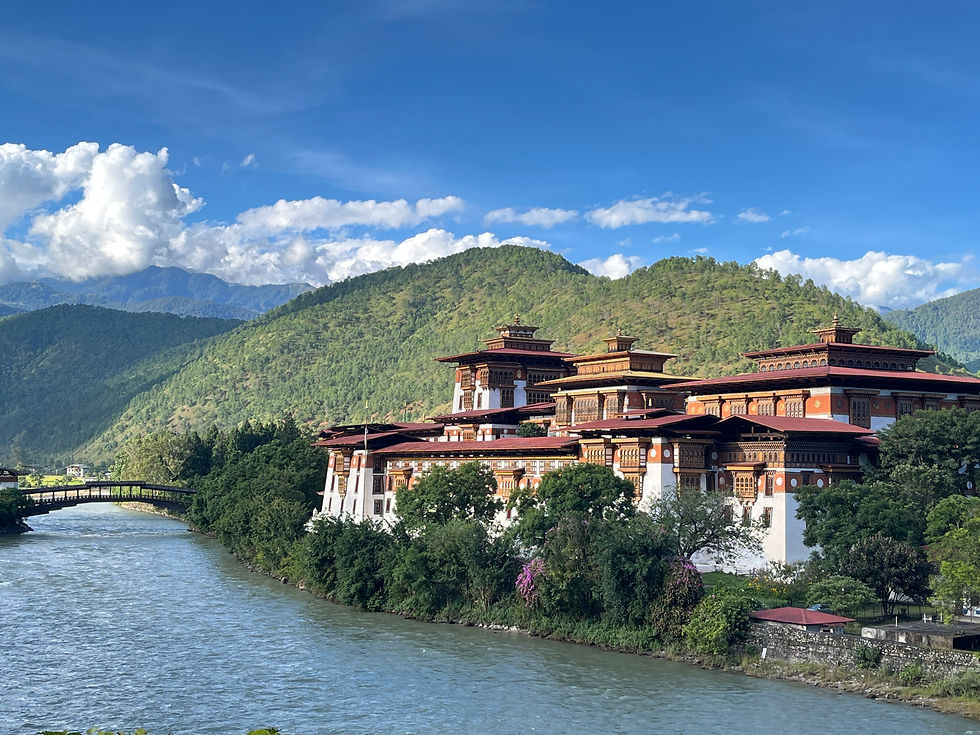
Continue to Punakha Dzong, one of Bhutan's most significant architectural and religious landmarks.
The dzong stands at the confluence of the Pho Chhu and Mo Chhu rivers and was built by Zhabdrung Ngawang Namgyel in the 17th century.
Punakha served as Bhutan's political and religious centre for centuries and remains the winter residence of the Central Monastic Body.
Khamsum Yulley Namgyal Chorten
Continue towards Khamsum Yulley Namgyal Chorten.
You can choose to hike through the countryside to the chorten, taking approximately 1½ hours round trip, depending on pace, or drive as close as road access permits.
Punakha Suspension Bridge
End the sightseeing day with a walk across the famous Punakha Suspension Bridge, decorated with colourful Buddhist prayer flags and stretching across the river.
Evening Option
If you would like a more local experience, take a stroll around Punakha or visit Kaja Throm, an outdoor food market where you can sample local food and refreshments.
Lunch: Local restaurantDinner & Overnight: Resort in Punakha
DAY 9 | PUNAKHA – THIMPHU – PARO
After breakfast, begin the journey towards Paro, passing through Thimphu.
Memorial Chorten
Stop in Thimphu to visit the National Memorial Chorten, built in memory of the Third King, His Majesty Jigme Dorji Wangchuck.
The chorten is an important religious landmark where local residents frequently come to circumambulate and pray.
Motithang Takin Preserve
Visit the Motithang Takin Preserve, home to Bhutan's national animal, the takin.
The animal has become one of the distinctive symbols of Bhutan and is closely associated with Bhutanese folklore.
Continue towards Paro.
Kyichu Lhakhang
Upon reaching the Paro Valley, visit Kyichu Lhakhang, one of Bhutan's oldest temples.
The temple is traditionally associated with the 7th-century Tibetan King Songtsen Gampo and is regarded as one of Bhutan's important sacred sites.
Continue to your hotel and relax.
Lunch: Local restaurantDinner & Overnight: Hotel in Paro
DAY 10 | PARO – TAKTSANG TIGER'S NEST
Today is one of the highlights of your Bhutan journey.
Taktsang Monastery – Tiger's Nest

After an early breakfast, drive to the trailhead at Ramthangkha and begin the hike to Taktsang Monastery, popularly known as Tiger's Nest.
The monastery is dramatically built on a cliffside above the Paro Valley and is one of Bhutan's most sacred pilgrimage sites.
According to Bhutanese Buddhist tradition, Guru Padmasambhava meditated here in the 8th century after arriving on the back of a flying tigress.
The hike generally takes several hours depending on pace and stops.
After returning from the hike, enjoy lunch before continuing with Paro sightseeing.
National Museum – Ta Dzong
Visit the National Museum of Bhutan, housed in the historic Ta Dzong above Paro.
The museum contains collections relating to Bhutanese art, culture, religion, history and natural heritage.
Paro Rinpung Dzong

Visit Rinpung Dzong, one of Paro's most recognisable landmarks.
Built under the direction of Zhabdrung Ngawang Namgyel in the 17th century, the dzong has served both religious and administrative functions.
Paro Town
End the day with free time to explore Paro town, shop for local products or simply enjoy the atmosphere of the valley.
Lunch: Local restaurant / Taktshang CafeteriaDinner & Overnight: Hotel in Paro
DAY 11 | DEPARTURE FROM BHUTAN
After breakfast, transfer to Paro International Airport for your onward flight.
Depending on your flight schedule, there may be time for a short walk through Paro town or a final opportunity to purchase Bhutanese handicrafts and local products.
Your YourBhutanTrip journey comes to an end.
Tashi Delek, and we hope to welcome you back to Bhutan someday.

YOURBHUTANTRIP
Travel Bhutan with local experts.
We are a Bhutan-based travel company focused on creating personalized, authentic and meaningful journeys through Bhutan.
Rather than simply taking you from one attraction to another, we want you to experience Bhutan through its people, stories, traditions, landscapes and everyday life.
Our Experiences
Cultural & Heritage Journeys
Buddhist & Spiritual Journeys
Himalayan Trekking
Festival Tours
Photography Journeys
Nature & Wildlife
Village & Local Experiences
Customized Private Tours
Your journey. Your pace. Your Bhutan.
YourBhutanTrip
Explore Bhutan with local experts.


Comments